Active Learning
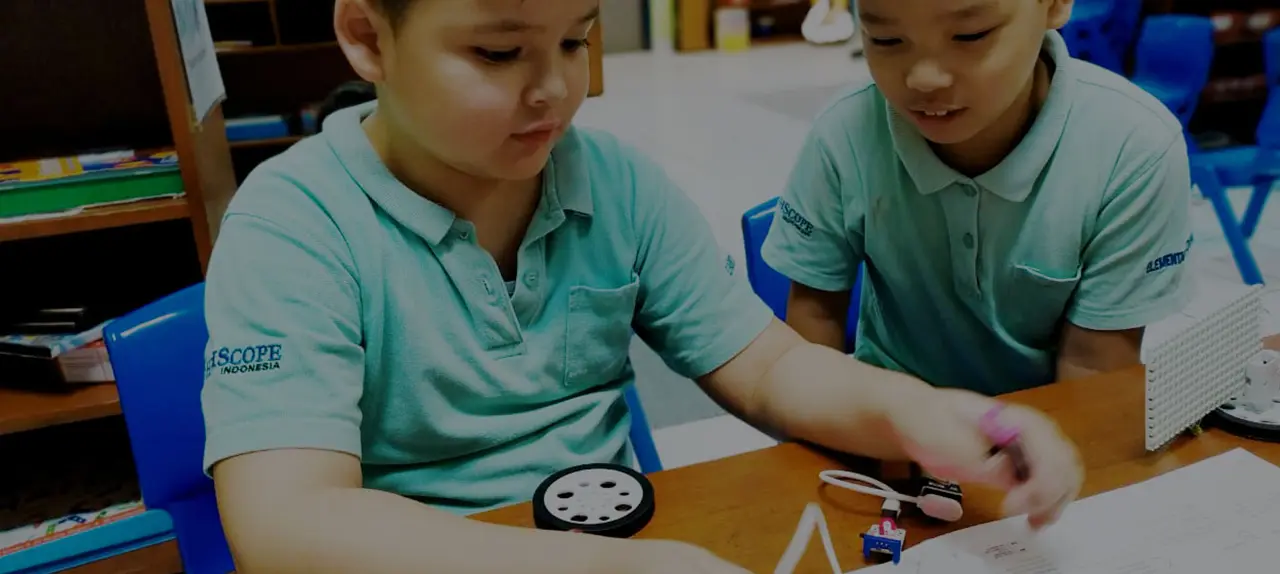
Active learning is at the center of the High/Scope elementary and middle school program educational approach. A child’s actively pursuing his/her own interests and intentions is the drive to learn and develop. Teachers allow this to happen by creating a learning environment in which children can set goals, choose and decide ways to achieve them, and follow through on their plans, working both independently and cooperatively. At the High/Scope Wheel of Learning, active learning forms the hub and is supported by other key elements:
1. The Daily Schedule
The High/Scope daily schedule incorporates:
- A consistent routine
- Plan-do-review sequence, in which students initiate plans for projects or activities, work in learning centers to carry out their plans, and then review what they have done. They make oral, written or other forms of presentations.
- Small group instructional workshops in content areas, such as mathematics, science, language and literacy, social studies, and special subjects (religion, art, music, and physical education)
- Balance of teacher-planned and child-planned activities
2. Teacher-Student Interaction
As it is defined in the active learning approach, children construct knowledge by actively interacting with people, events, ideas, teachers using the High/Scope method and are aware that teaching and learning are social processes. Thus, the teachers’ role is to:
- Support and extend children’s learning by engaging in instructional dialogue.
- Share control with the children.
- Work to create a positive social environment.
- Support children’s intrinsic motivation to learn.
3. Assessment
The philosophy that guides teachers in assessing children is that children come to learn, not to be tested. High/Scope teachers support, observe, record, and report children’s academic and social-emotional progress. They keep anecdotal notes about children’s significant behaviors to help them better understand children’s interests, developmental progress, and ways of thinking and learning. Teachers also collect, select, and assess student work in portfolios. All the processes are guided by the High/Scope key experiences.
Besides assessing children, teachers also evaluate what happened during the day before planning for the next day – adjusting their classrooms and activities to meet children’s needs.
4. Content
What is covered in content is:
- Scope and sequence defined by key experiences in math, language and literacy, science, music and movement, etc.
- Teacher-planned daily workshop times focusing on key content areas
- Child-planned activities related to key experiences
5. Learning Environment
The High/Scope learning environment provides a wide-range of interesting materials that invite children to engage in educational experiences. The materials are developmentally appropriate and provide children with experiences in content areas, such as mathematics, language and literacy, science, social studies, art, music and movement. Children’s individual learning styles and intelligences are also taken into consideration when providing materials.
Children are also given opportunities to use computers and developmentally appropriate software. Working with computers is also viewed as part of learn-to-learn skills that allows children to conduct research and write reports, etc.
The High/Scope learning environment is well-organized. Each classroom contains five or more distinct activity areas, such as math center, reading center, writing center, art center, science center, social studies center, and computer center. In each center materials are stored in consistent places that are accessible for children.
The arrangement of the environment accommodates individual, small-group, and whole-group activities.
6. Recognition
Sekolah High/Scope
Indonesia have been honored as a member of The Western Association of
Schools and Colleges (WASC), an organization that is recognized as
one of six regional associations that accredit public and private
schools, colleges, and universities in the United States.
The Western region
covers institutions in California and Hawaii, the territories of Guam,
American Samoa, Federated States of Micronesia, Republic of Palau,
Commonwealth of the Northern Marianas Islands, the Pacific Basin, and
East Asia, and areas of the Pacific and East Asia where
American/International schools or colleges may apply to it for service.